Business Registration Process for Foreign Company in Ghana 2026 Guide
By Kent Tougan February 26, 2026
Foreign companies seeking direct investment in Ghana must navigate a structured registration process primarily governed by the Office of the Registrar of Companies (ORC) and the Ghana Investment Promotion Centre (GIPC). The landscape for investing in Ghana has fundamentally shifted with the passage of the Ghana Investment Promotion Authority (GIPA) Bill, 2026. This landmark reform replaces the old GIPC Act 865 and is designed to position Ghana as the leading hub for the African Continental Free Trade Area (AfCFTA)
Ghana has long been recognized as a beacon of economic stability and growth in West Africa, making it an attractive destination for foreign direct investment (FDI). Its robust democracy, strategic location, and expanding market offer significant opportunities for international businesses looking to establish a foothold in the region. If you’re a foreign company considering direct investment in Ghana, understanding the latest business registration process is crucial for a smooth and successful entry.
Why Ghana? The Allure for Foreign Investors
Before delving into the “how-to,” let’s briefly touch upon the “why.” Ghana’s appeal to foreign investors stems from several key factors:
Political Stability: A consistent democratic record provides a predictable and secure environment for business operations.
Growing Economy: Ghana boasts one of the fastest-growing economies in Africa, driven by sectors like oil and gas, mining, agriculture, and an emerging technology scene.
Strategic Location: Situated on the coast of West Africa, Ghana offers excellent access to regional markets and international trade routes.
Abundant Resources: Rich in natural resources, including gold, cocoa, and oil, Ghana provides raw materials and investment opportunities across various industries.
Developing Infrastructure: Ongoing investments in roads, ports, and digital infrastructure are enhancing connectivity and ease of doing business.
Investment Incentives: The government actively promotes FDI through various tax holidays, exemptions, and special economic zones.
The Ghanaian government is committed to creating an enabling environment for businesses, continuously streamlining processes and introducing investor-friendly policies.
Analytically, the 2025 GIPC Act amendments scrap minimum equity requirements (previously $500,000 for wholly foreign-owned firms), shifting to risk-based screening for viability and compliance, this reduces barriers but raises concerns over low-commitment ventures crowding local markets.
Understanding the Key Regulatory Bodies
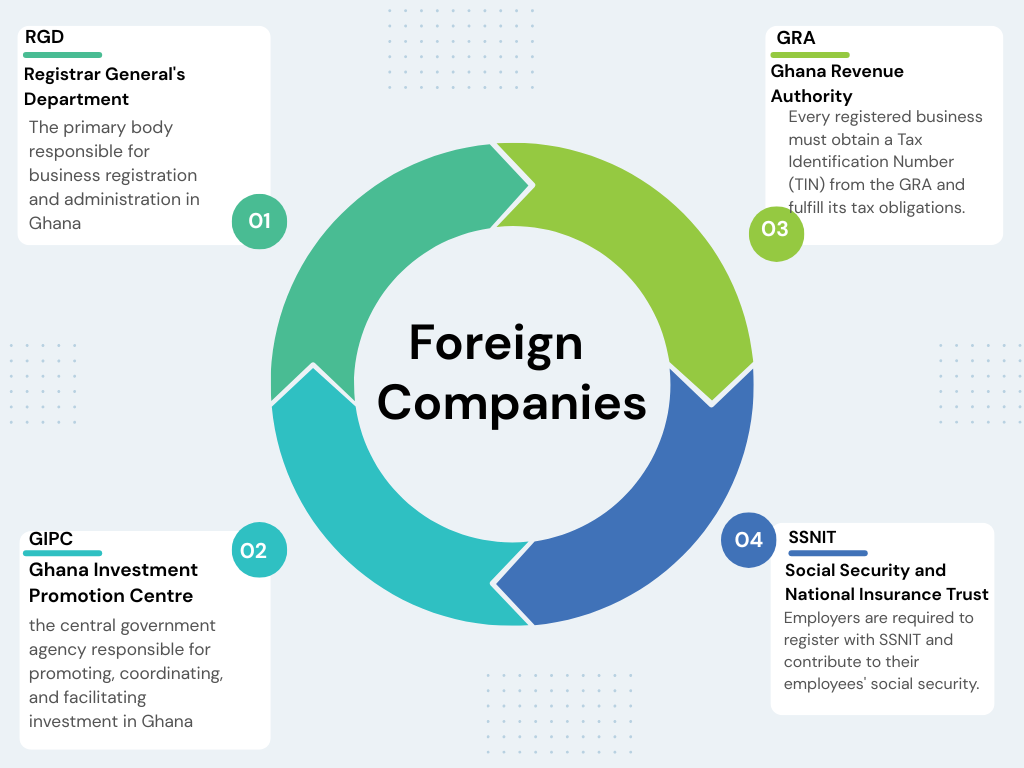
Navigating the business registration landscape in Ghana requires interaction with several key government agencies. Familiarity with their roles will significantly aid your registration journey:
Registrar General’s Department (RGD): This is the primary body responsible for business registration and administration in Ghana. All companies must be registered here.
Ghana Investment Promotion Centre (GIPC): The GIPC is the central government agency responsible for promoting, coordinating, and facilitating investment in Ghana. Foreign companies seeking to invest directly in Ghana must register with the GIPC after incorporating with the RGD, especially if they wish to enjoy certain investment benefits and guarantees.
Ghana Revenue Authority (GRA): Every registered business must obtain a Tax Identification Number (TIN) from the GRA and fulfill its tax obligations.
Social Security and National Insurance Trust (SSNIT): Employers are required to register with SSNIT and contribute to their employees’ social security.
Key Regulatory Bodies for foreign companies in Ghana
The process has become increasingly digitized and efficient, thanks to ongoing reforms. Here’s a detailed breakdown of the steps involved:
Ghana has officially lowered the barriers to entry for global entrepreneurs.The 2026 regulatory reforms have transitioned the GIPC into the Ghana Investment Promotion Authority (GIPA), introducing more flexibility and digital efficiency for foreign investors.
Step 1: Determine Your Business Entity
While there are several options, most foreign investors opt for a Company Limited by Shares. Under the new bill, “External Companies” (branch offices) are also more clearly defined and encouraged for those looking to maintain a direct link to a parent company abroad.
Step 2: Reserve Your Name & Digital Incorporation
Start by searching and reserving your company name via the Office of the Registrar of Companies (ORC) portal.
Action: Submit the Company Constitution and Form 3, which lists your Directors, Secretary, and Shareholders
Requirement: At least one director must be a resident of Ghana.
Step 3: Understand the 2026 Minimum Capital Reforms
This is the most significant update for your readers. The 2026 Bill has shifted from blanket capital requirements to a sector-specific approach:
Non-Trading Sectors (Manufacturing, Tech, Services, etc.): The mandatory minimum capital of $500,000 (wholly foreign) or $200,000 (Joint Venture) has been eliminated. You can now enter these markets based on your actual operational needs.
Trading Enterprises: To protect local retail markets, a minimum capital requirement remains but has been reduced to $500,000 USD (down from $1M).
Employment Rule: Instead of a fixed number of employees, trading companies must now ensure that 75% of their skilled workforce are Ghanaian citizens.
Step 4: Register with the Ghana Investment Promotion Authority (GIPA)
Once incorporated at the ORC, you must register with the newly formed GIPA before commencing operations.
Annual Renewal: Note that the 2026 Bill replaces the old two-year renewal cycle with a mandatory annual renewal to ensure data accuracy and compliance.
One-Stop Shop: GIPA now acts as a “one-stop-shop,” facilitating your interaction with other agencies like Immigration and the Revenue Authority.
Step 5: Tax and Social Security Compliance
GRA Registration: Obtain your Tax Identification Number (TIN) and register for VAT.
SSNIT: Register your employees for social security. Under the new bill, there is a heavier emphasis on local skills development and gender-inclusive hiring practices.
Step 6: Secure Local Permits
Depending on your sector (especially in Agro-Processing or Manufacturing), you will need specific permits from:
The Environmental Protection Agency (EPA)
The Ghana Standards Authority (GSA) or Food and Drugs Authority (FDA).
Your local Metropolitan/Municipal Assembly (Business Operating Permit).
It is crucial to identify all necessary sector-specific licenses early in your planning process to avoid delays.
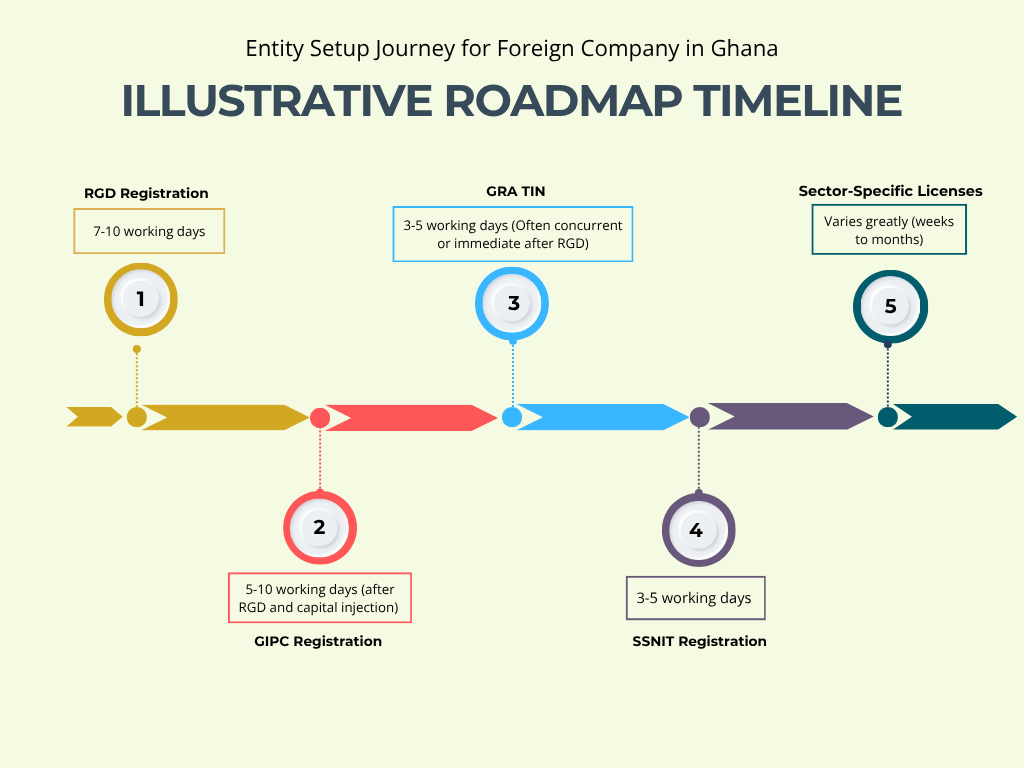
NB: Commencement of Business within 1-2 weeks. Foreign applicants note 1% stamp duty on stated capital.
While efficiency has improved, the timeline can vary depending on the completeness of your documentation and responsiveness to queries.
Entity Setup Journey for Foreign Company in Ghana
Important Considerations for Foreign Investors
Local Resident Director/Secretary: The requirement for a resident director and a professionally qualified resident company secretary is non-negotiable.
Bank Account: Open a corporate bank account in Ghana as early as possible to facilitate capital injection and local transactions.
Professional Assistance: Engage local legal counsel, accountants, and business consultants. They can provide invaluable guidance, ensure compliance, and expedite the process.
Due Diligence: Conduct thorough due diligence on potential partners, suppliers, and market conditions.
Immigration: For foreign staff, ensure proper work permits and visas are obtained from the Ghana Immigration Service (GIS).
Virtual Office/Physical Location: While initial registration can begin, a verifiable physical address for your registered office is mandatory.
The Digital Transformation: E-Registrar and Online Portals
Ghana has made significant strides in digitizing its business registration services. The Registrar General’s Department now offers an E-Registrar portal, allowing for online company name searches, reservations, and submission of registration documents. The GIPC also leverages online platforms for certain aspects of its registration and reporting.
This move towards digitalization aims to:
Reduce processing times
Enhance transparency
Minimize physical interactions and associated bureaucratic hurdles
Improve ease of doing business
While the online platforms simplify many steps, it’s still advisable to seek professional guidance, especially for first-time investors unfamiliar with local nuances.
Explore how your investment can thrive in Ghana’s round-the-clock economy. ContactGround Partners today to learn more about specific sector opportunities and how you can be a part of this exciting transformation by leveraging on our Solution.


 By Kent Tougan
February 26, 2026
By Kent Tougan
February 26, 2026