The Legalities of Land Ownership for Foreign Companies in Ghana: A Strategic 2026 Guide
By Kent Tougan March 20, 2026
For foreign direct investors, land is often the most critical asset in the “market entry” journey. While Ghana is open for business, its land laws are protective. Understanding the distinction between Freehold and Leasehold is the difference between a secure investment and a legal nightmare.
1. The Golden Rule: Leasehold vs. Freehold
Under Article 266 of the Ghana Constitution and Section 10 of the Land Act, 2020, the rules for non-citizens (individuals or foreign-controlled companies) are absolute:
– Freehold Ownership: Strictly prohibited for non-citizens.Any attempt to sell freehold land to a foreigner is legally void.
– Leasehold Interest: Foreigners and foreign-owned companies can only hold land on a leasehold basis.
– The 50-Year Cap: For non-citizens, the maximum duration for a single lease term is 50 years.
Important for 2026: A company is classified as “non-citizen” if more than 40% of its equity is held by non-Ghanaians.Even if your company is registered in Ghana, this “40% rule” determines your land ownership limits
2. Types of Land in Ghana
Knowing who you are dealing with is half the battle. Ghana’s land falls into four main categories:
Land Category
Ownership
Key Consideration for Investors
Public/State Land
The Government of Ghana
Usually the most secure; leased through the Lands Commission.
Vested Land
Held by the State in trust for Stools
Administered by the Lands Commission on behalf of traditional authorities.
Customary/Stool Land
Traditional Authorities (Chiefs/Skins)
Requires “Concurrence” from the Lands Commission to be valid.
Family/Private Land
Specific Families or Individuals
Requires verifying the “Allodial” (ultimate) owner to avoid “double-selling.”
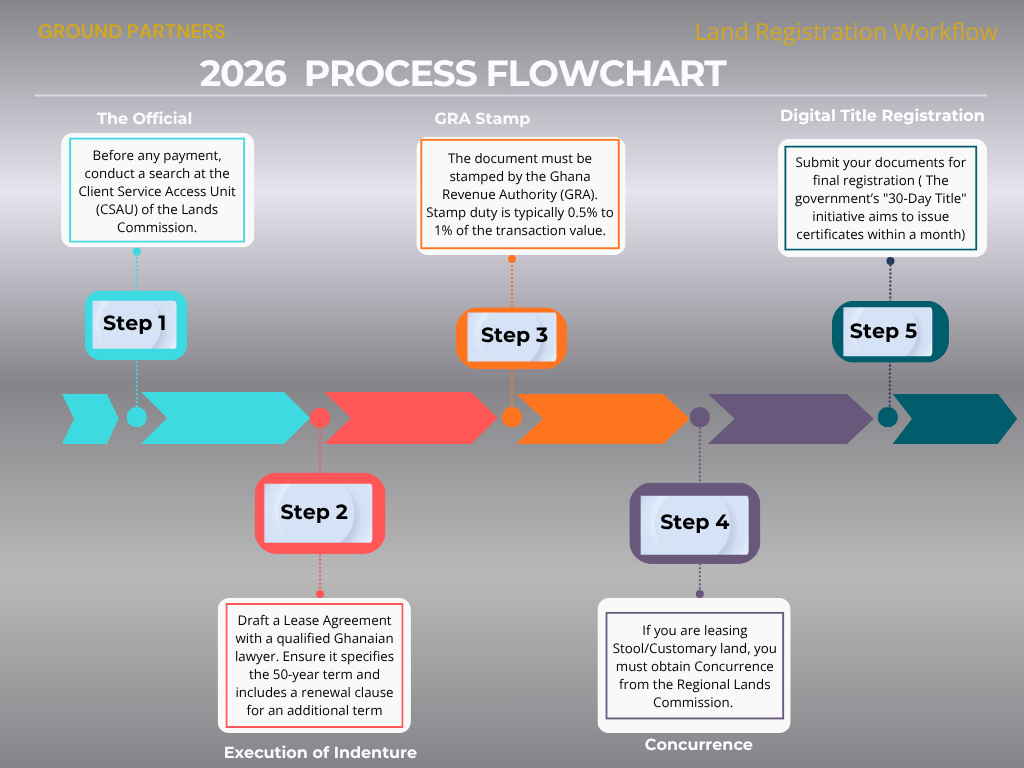
3. The 2026 Digital Registration Workflow
The Ministry of Lands and Natural Resources has successfully transitioned to a Paperless Land Title System. Here is the current 5-step process:
Step 1: The Official Search
Before any payment, conduct a search at the Client Service Access Unit (CSAU) of the Lands Commission
– 2026 Update: Most searches can now be initiated online. This verifies if the seller is the true owner and if there are any existing encumbrances or court disputes.
Step 2: Execution of Indenture (Lease Agreement)
Draft a Lease Agreement with a qualified Ghanaian lawyer. Ensure it specifies the 50-year term and includes a renewal clause for an additional term, though this is subject to negotiation with the grantor.
Step 3: Stamping at the GRA
The document must be stamped by the Ghana Revenue Authority (GRA).Stamp duty is typically 0.5% to 1% of the transaction value. This is a legal prerequisite for registration
Step 4: Concurrence (For Stool Lands)
If you are leasing Stool/Customary land, you must obtain Concurrence from the Regional Lands Commission. Without this, your lease is legally unenforceable.
Step 5: Digital Title Registration
Submit your documents for final registration.
– Performance Target: The government’s “30-Day Title” initiative aims to issue certificates within a month, though realistically, investors should factor in 3–6 months for complex commercial parcels.
A 2026 Land Registration Process Flowchart in Ghana for Foreign Companies
The Land Act, 2020, criminalizes the use of “Land Guards” (unauthorized security). Engaging them or being harassed by them is a serious offense. The 2026 enforcement regime carries stiff prison sentences (5–15 years) for these activities.
Spousal Consent
If you are buying from an individual or family, ensure the Spousal Consent clause is met. Under Act 1036, a spouse cannot sell “jointly acquired land” without the written consent of the other partner.
Environmental Permits
For Agro-Processing or Manufacturing, land ownership is only the first step. You must secure an Environmental Permit from the EPA before breaking ground.
. Verify Citizen Status: Does your company have >40% foreign equity? (If yes, 50-year cap applies).
. Digital Search First: Never pay a deposit without a Lands Commission Search Certificate.
. Check Zoning: Ensure the land is zoned for “Industrial” or “Commercial” use.
. GIPA Registration: Ensure your land investment is captured in your GIPA (formerly GIPC) registration for investment protection.
Conclusion
While the 50-year leasehold might seem restrictive, it is a standard and secure framework that has supported billions in FDI. By leveraging the new digital registration tools and ensuring strict due diligence, foreign companies can secure the “ground” they need to scale in Ghana’s 24-hour economy.



 By Kent Tougan
March 20, 2026
By Kent Tougan
March 20, 2026